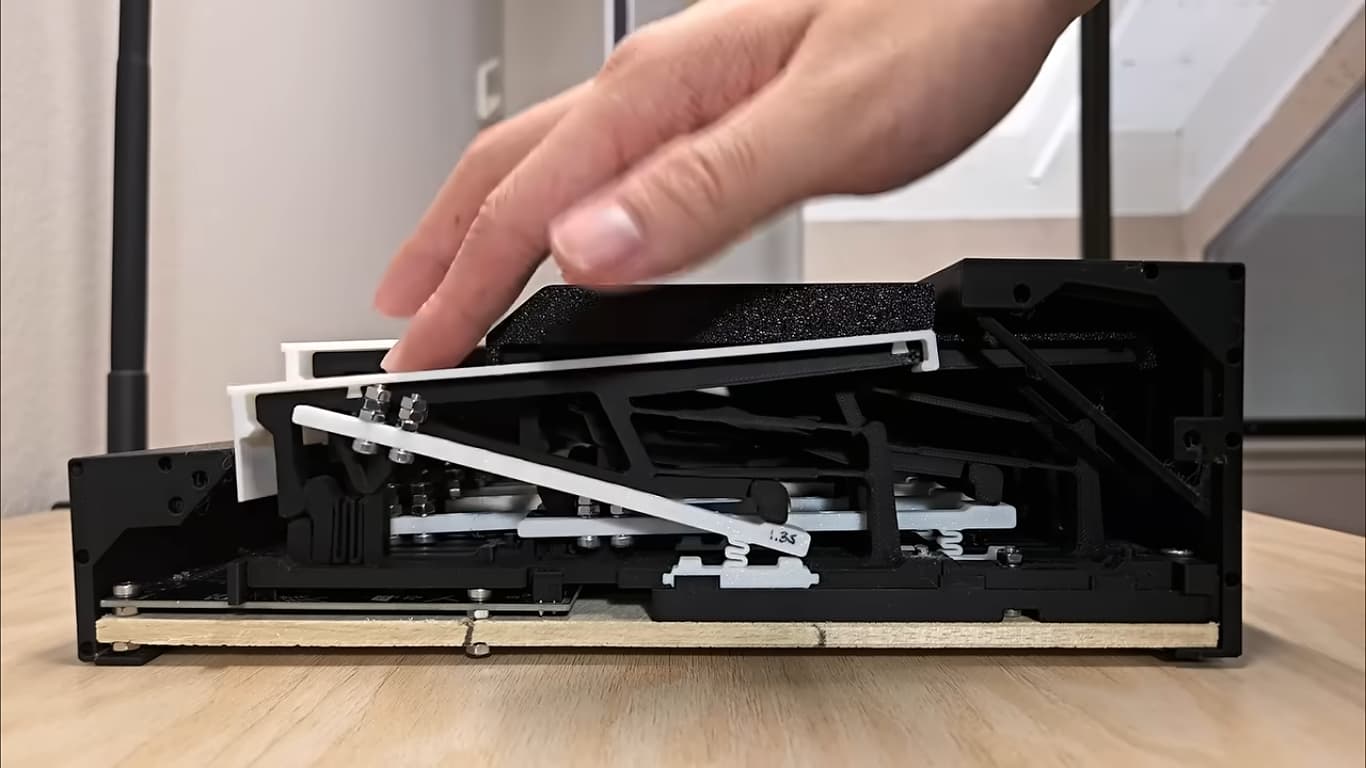
A builder known as dovetail has 3D printed a functional grand piano action in a matter of weeks, replicating a mechanism that took instrument makers roughly 150 years to refine. The action handles hammer velocity control, rebound prevention, repetition for rapid restrike, and string damping after key release. All of it, compressed into printed plastic.
The key engineering choice is compliant mechanisms: solid parts designed to flex in precise, controlled ways instead of relying on traditional hinged assemblies. The design went through multiple iterations to match the tactile feel of a real acoustic action. The result is a hybrid instrument with physical keys and digital sound output, using infrared sensors to drive MIDI. PCBs are daisy-chained in a modular layout, one board per key group, so the system scales across a full keyboard.
The prototype debuted at Open Sauce, where musicians played it publicly. Dovetail has identified three concrete upgrades: swapping IR sensors for hall effect sensors, revising the action geometry, and switching filament materials. The original piece is worth reading for the detailed breakdown of how compliant mechanisms stand in for each discrete moving part in a traditional action, and for the roadmap of what comes next.
[READ ORIGINAL →]